Important: This article is general information, not legal advice. Rules, fees, and required documents can vary by location and by authority. For a purchase decision, always verify documents with the relevant authority and review everything with a qualified property lawyer.
If you are planning to buy a flat, the biggest risk is usually not design or paint—it’s property documentation and legal compliance. Whether you’re buying from a housing development company Bangladesh or considering a resale flat, this guide helps you understand what to check, what to ask for, and how to reduce legal risk.
Step 1: Understand what “RAJUK approved” really means (Dhaka-specific)
In Dhaka, RAJUK (Rajdhani Unnayan Kartripakkha) is the key authority for urban planning and building permissions. When people say a building is RAJUK approved, the safest meaning (for buyers) is:
- The land and use are allowed for that type of development (often referred to as land-use clearance / land-use permission in Dhaka planning context).
- The building has a sanctioned/approved building plan by the authority.
- The construction matches the approved plan (no major unauthorized deviations).
- Where applicable, the building has post-construction permission/certification to occupy (often called an occupancy certificate in common usage).
If you are not buying in Dhaka: RAJUK may not be the relevant authority. Ask your lawyer which local development authority’s approvals apply in that city/area.
Step 2: Shortlist only trusted developers (before you pay a booking)
Many buyers search “best developer in Dhaka” or “real estate developers Bangladesh” and choose based on ads. Instead, shortlist using evidence:
- Delivery track record: completed projects and on-time handover history.
- Document transparency: willingness to show approvals and land documents.
- Clear handover terms: written handover checklist and timeline.
- After sales service: a defined process for defects, maintenance, and support after possession.
Step 3: Collect the “core documents pack” (ask for copies early)
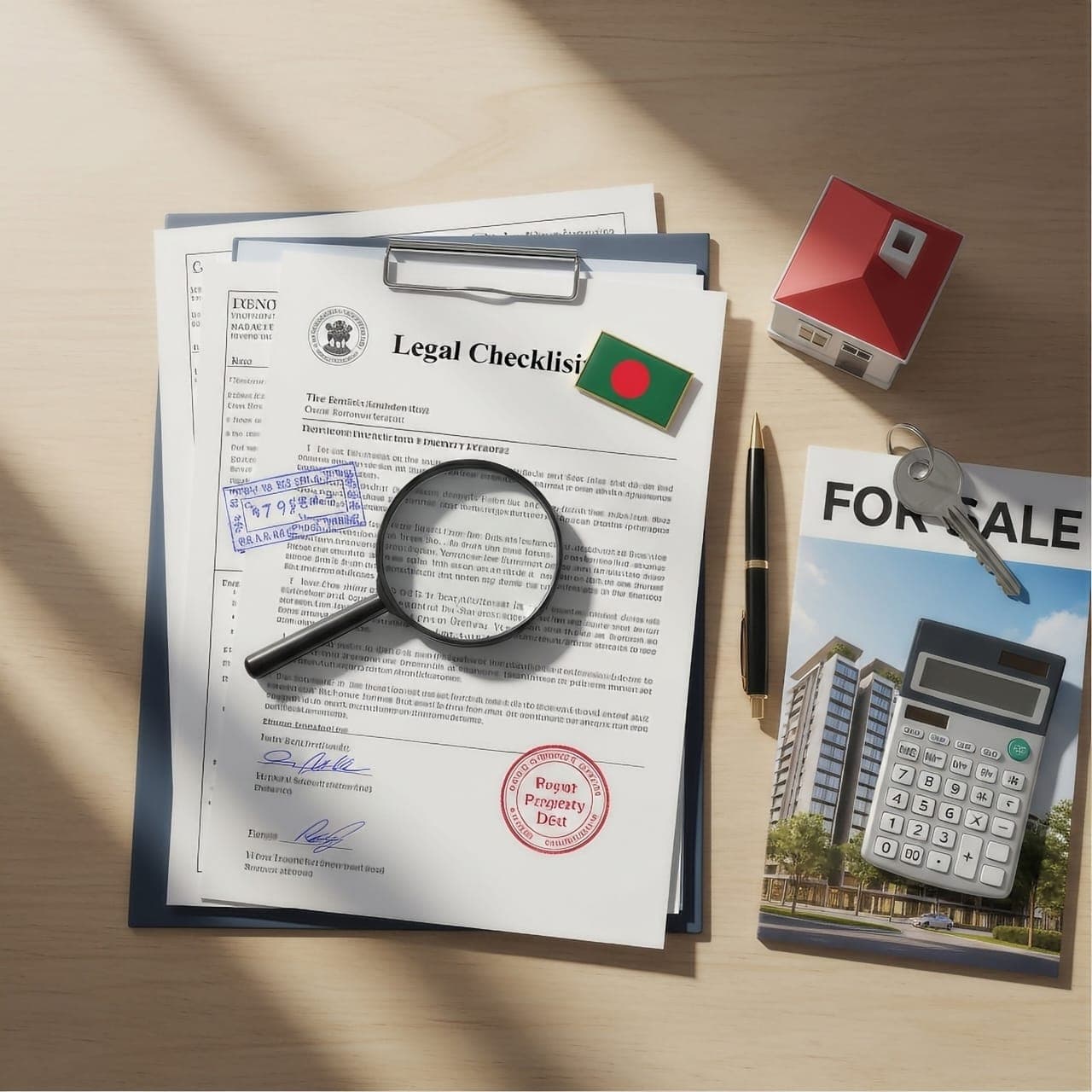
Ask the seller/developer for a document pack. Your lawyer should verify authenticity and consistency across documents.
| Category | What to ask for | Why it matters |
|---|---|---|
| Ownership / Title | Title deed(s), mother deed, chain of ownership documents | Confirms legal ownership and reduces dispute risk |
| Land Records | Mutation/namjari record, khatian/record of rights (as applicable), updated tax receipts | Confirms records match ownership and taxes are up to date |
| Encumbrance / Claims | Encumbrance / mortgage / lien status confirmation (your lawyer can run checks with the sub-registry) | Avoids buying a flat tied to loans, disputes, or restrictions |
| Planning & Approvals (Dhaka) | RAJUK-approved building plan and related permissions | Supports “RAJUK approved” claim and compliance with planning rules |
| Utilities / NOCs | Utility connection papers (water/electricity/gas where applicable) + dues clearance | Prevents service disputes and unpaid bill liability |
Step 4: Verify the building matches the approved plan (common hidden risk)
Even if a project is advertised as RAJUK approved, problems occur when the constructed building differs from the approved plan (for example: extra floors, changed parking layout, reduced setbacks, or altered common areas). Ask:
- Is the as-built layout consistent with the approved plan?
- Is the parking allocation defined clearly for your flat?
- Are there any deviations or pending regularization issues?
This matters for safety, future resale, financing, and avoiding future legal complications.
Step 5: Confirm safety/code alignment (use careful wording)
Buyers often hear “BNBC compliant” (Bangladesh National Building Code). As a buyer, you typically can’t “prove” full compliance yourself—but you can reduce risk by requesting:
- Structural design documentation (reviewed by a qualified engineer).
- Fire safety measures and building safety provisions as applicable.
- Evidence that approvals were obtained through proper channels (not only verbal claims).
Step 6: Review the sale agreement like a checklist (before you pay major money)
Whether you choose a ready flat or an ongoing project, the contract is where your protection lives. Make sure the agreement clearly states:
- Exact flat details: floor, unit, size measurement method, parking, storage, and common area rights.
- Payment schedule: milestones, what triggers each payment, and receipt requirements.
- Handover date: a realistic timeline and what happens if delayed (penalty/compensation terms, if any).
- Finishes/specs: tiles, fittings, lift brand, generator capacity, security system—written, not promised verbally.
- Defects liability: what repairs the developer must do after handover and for how long.
- After sales service: the process, contact channel, and service timeline after possession.
Step 7: Registration & transfer (what’s generally true, and what to verify)
In Bangladesh, ownership transfer typically requires a properly executed and registered deed at the sub-registrar/sub-registry office. Requirements and steps can vary based on:
- New purchase vs resale
- Developer-owned land vs authority-developed schemes
- City/authority rules
Recent policy updates have been reported indicating certain transfers may not require separate approval from RAJUK (in specific contexts). Because applicability can depend on where the flat is and who developed it, treat this as a “verify with lawyer” point, not a shortcut.
Step 8: Handover day checklist (don’t skip this)
Before final payment/possession, do a structured handover check:
- Physical inspection: leaks, cracks, tile level, door alignment, windows, bathroom slope, electrical points.
- Utilities: water pressure, generator backup, meter details (as applicable).
- Common areas: lift operation, stairwell, rooftop access rules, security desk.
- Document handover: copies of approvals, flat-related papers, payment receipts, and any handover/possession certificate used in your transaction.
Step 9: A simple decision framework (Dhaka buyers)
If you’re looking at real estate in Dhaka (for example Gulshan, Bashundhara R/A, or Baridhara) and you want to buy apartment in Dhaka safely, use this rule:
- No document pack = no booking.
- No verified approvals = no major payment.
- No clear handover + after-sales terms = reconsider the developer.
Conclusion
Buying a flat in Bangladesh can be a great decision—especially when you choose a trusted housing development company Bangladesh with transparent documentation and strong service. Use the checklist above to confirm RAJUK approved status where applicable, protect yourself with proper property documentation, and insist on clear legal compliance, handover, and after sales service terms.